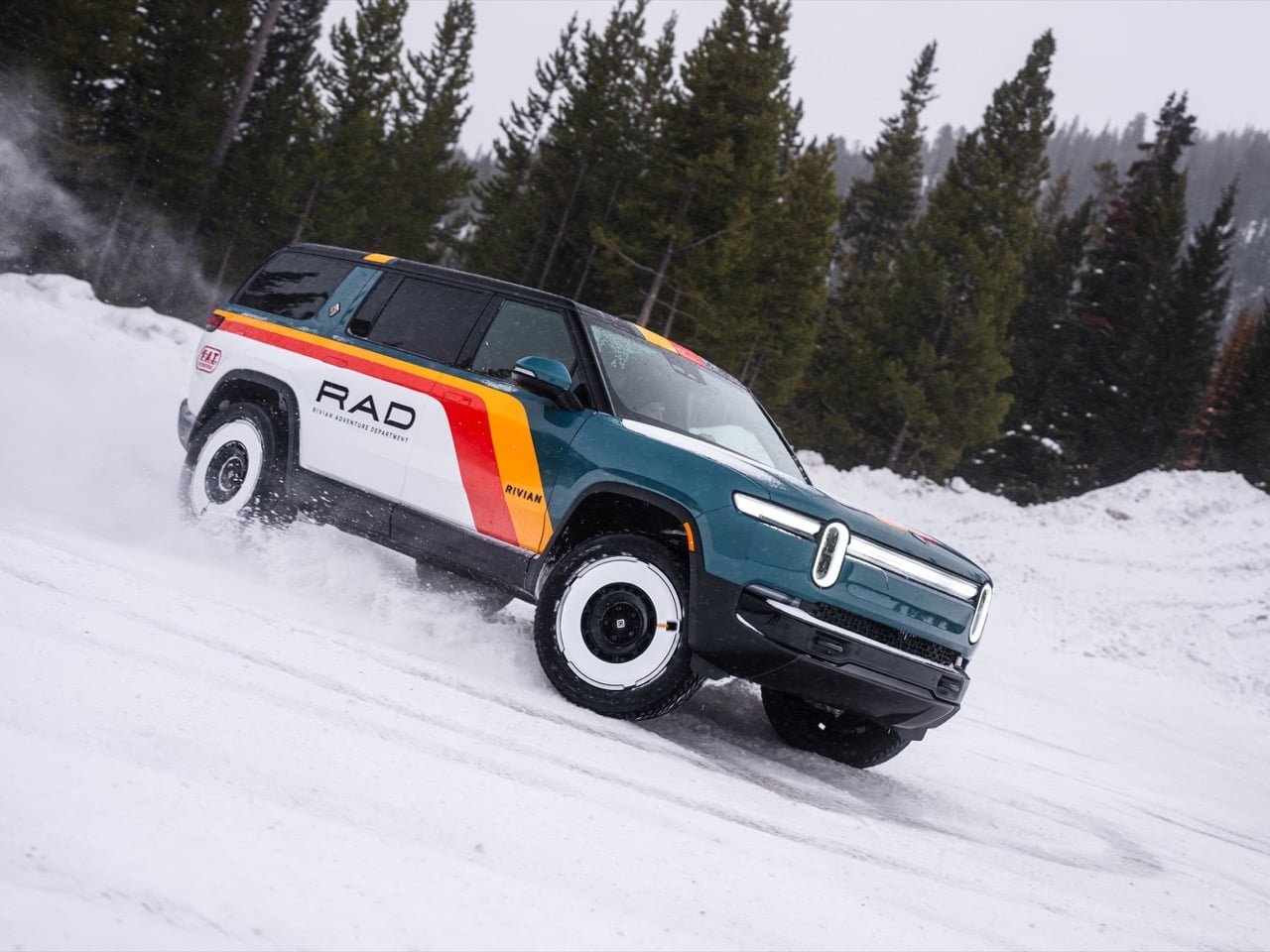
Meet RAD, short for Rivian Adventure Department, which is either a very clever name or a very brave one. In practical terms, it is Rivian’s newly formalized performance and development group. The team takes its trucks and SUVs into demanding events, learns what breaks, what grips, what flies, and channels those lessons into future products and features. It has been operating inside Rivian for years without a formal name. Think of it as Rivian’s version of BMW M or Toyota GR, except its proving ground is desert rallies and frozen lakes rather than the Nurburgring.
Rivian unveiled RAD at the 2026 FAT Ice Race in Big Sky, Montana, which feels like the correct setting for a division built around speed, control, and chaos management. FAT stands for Fahren auf Eis, German for “driving on ice,” and the event mixes vintage cars, modern performance machines, and now, 1,025-horsepower electric SUVs. The quad-motor R1S came in second on RAD’s debut, a solid first result. The bigger story is what RAD signals about where Rivian is heading. The company had the adventure image locked down already, and it now wants a firm grip on performance too, seemingly content to make that argument sideways on ice.
Designer: Rivian

RAD’s first deliverable for actual owners is the RAD Tuner, and it is more substantive than a typical software feature drop. It gives quad-motor R1S and R1T owners on Gen 2 hardware touch sliders to build custom drive modes across more than 10 powertrain and suspension variables, including power output, torque bias, stability control intervention, and brake regeneration. Two presets come built in: Desert Rally, developed from Rebelle Rally data, and Hill Climb, shaped by Pikes Peak runs. Both modes came from a team driving a 1,025-horsepower EV through punishing terrain and noting what actually worked. That feedback loop between competition and production software is what separates a real performance division from a badge on a brochure.

Speculation around RAD-badged production models is already building, and Rivian is doing nothing to quiet it. The R2, Rivian’s more compact SUV arriving in the second half of 2026, showed up at the FAT Ice Race dressed in full RAD livery, which is not a styling accident. The Drive has laid out the theory that quad-motor R1 models get rebranded R1 RAD, with a tri-motor R2 in the R2 RAD slot. When Rivian’s spokesperson was asked about the conspicuously missing R2 tri-motor from the launch lineup, the reply was “so much more to come” with an actual winking emoji. If RAD graduates to a production badge, Rivian enters the same conversation as the Ford Raptor, the Ram TRX, and every performance sub-brand that has figured out how to charge a premium for pushing factory hardware past its polite defaults.

The EV industry has spent years anchored to range figures and charging infrastructure debates, both necessary conversations, but ones that leave genuine enthusiasm largely unaddressed. Rivian is making the argument loudly that electric trucks can be athletic, competition-tested, and interesting to the crowd that wakes up on a Saturday morning wanting to do something dumb and fast. The RAD Tuner is a modest first chapter, but the direction is unambiguous. Performance divisions grounded in real competition data take years to build and are hard to fake from scratch. Rivian has that foundation in place.

The post Rivian Just Launched Its Own Version of BMW M, and It’s Called RAD (Rivian Adventure Department) first appeared on Yanko Design.


0 Commentaires