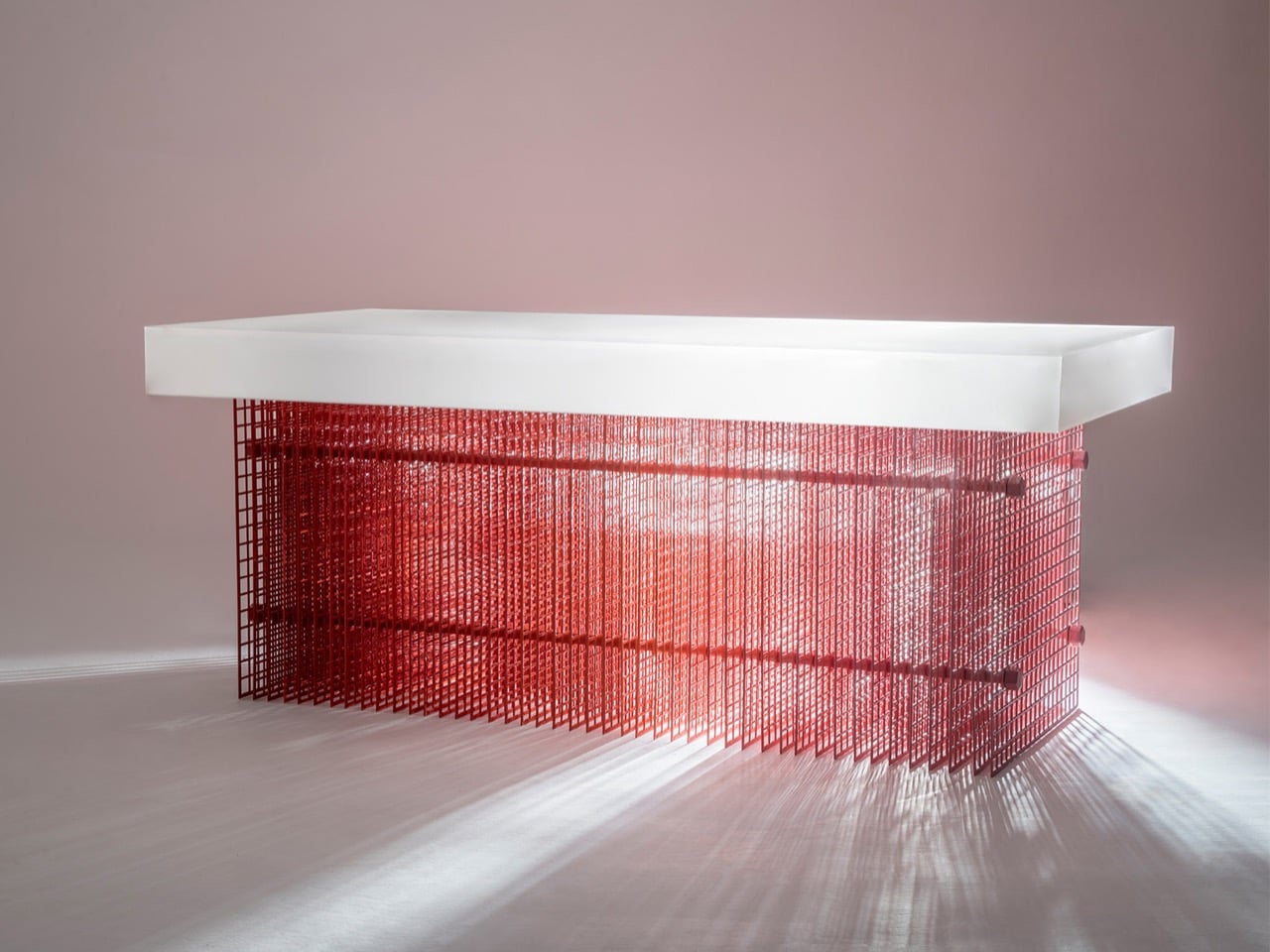
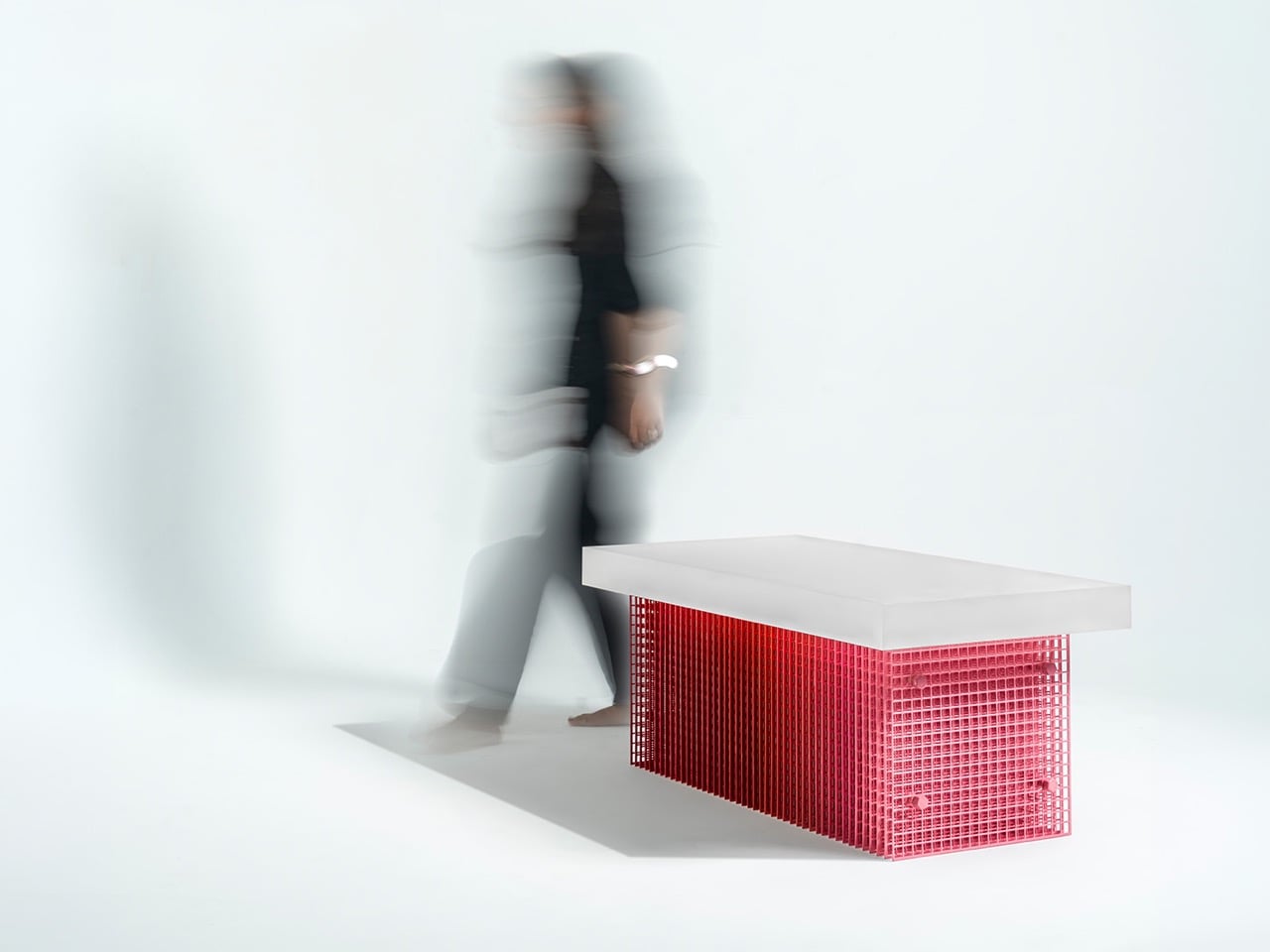
Dhruv Agarwwal’s Blur coffee table is named for what it does to your eyes. The base is a structure of layered steel mesh, each plane sitting close enough to the next that their overlapping grids produce a moire effect across the surface, a shifting, shimmering interference pattern that changes character with every degree of movement from the viewer. The red Meena enamel coating, applied by hand by artisans in Moradabad, intensifies the effect: the slight inconsistencies of hand-application mean the color itself is uneven, denser in some areas, thinner in others, feeding directly into the optical noise.
Above the mesh base floats a frosted acrylic tabletop, thick and rectangular, diffusing rather than reflecting light. The pairing of the two materials produces a coherent visual argument: both surfaces refuse to be fully legible. One shimmers and shifts; the other glows and obscures. Together they make a table that rewards extended looking in a way that polished stone or clear glass simply cannot.
Designer: Dhruv Agarwwal
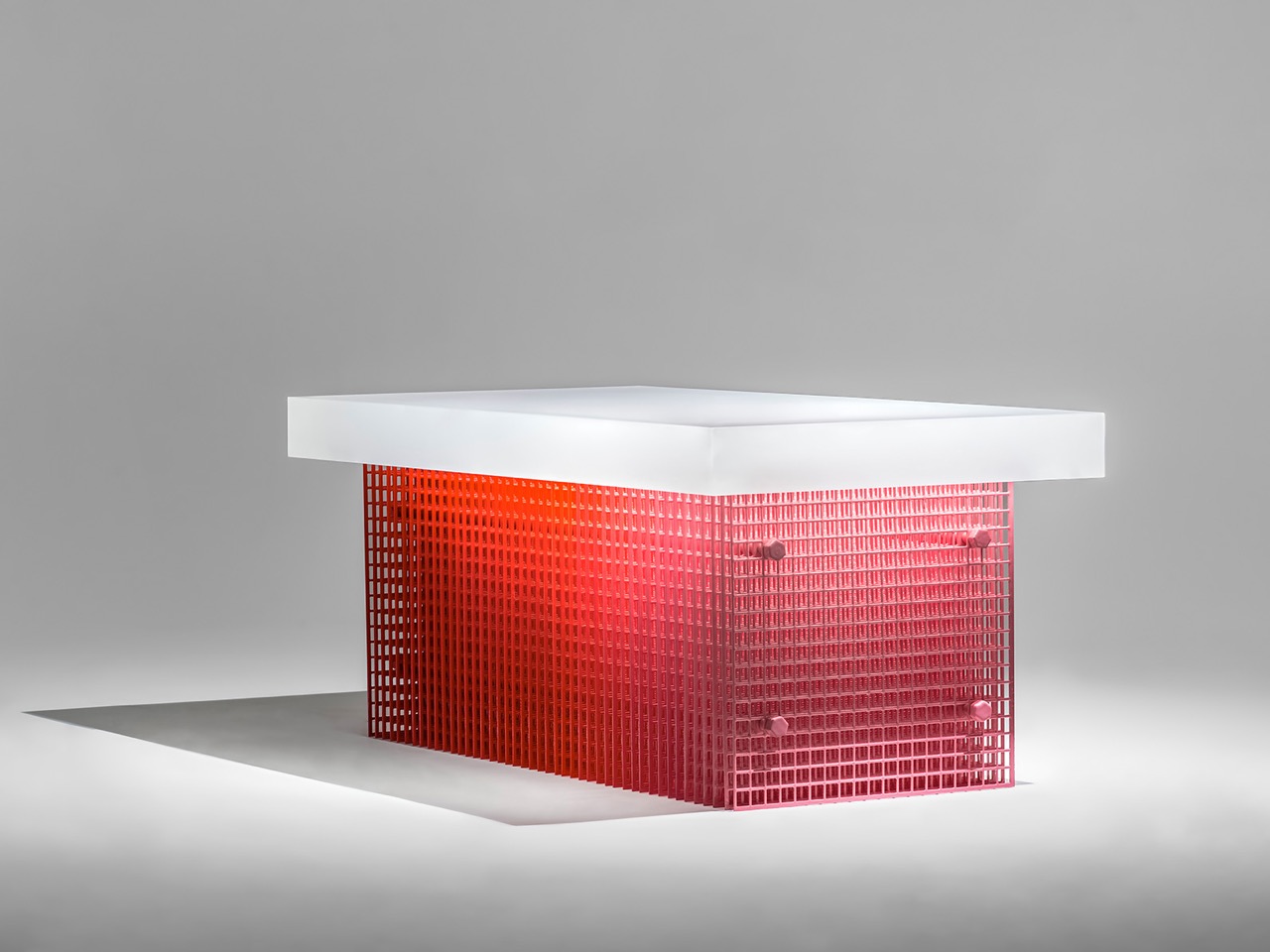
Meena enamel is a craft with serious heritage. Originating in Rajasthan and practiced extensively across Moradabad, it involves fusing powdered glass onto metal at high temperatures, a process that demands precision and repetition and produces a surface that no two artisans will render identically. Agarwwal worked with local craftspeople to develop a thicker enamel coat than the technique typically yields, which is a meaningful technical decision because thickness changes how the enamel interacts with light, giving it volume and depth rather than lying flat against the wire. On a steel mesh substrate, that depth becomes optical complexity. The wire catches the enamel unevenly, creating micro-variations across thousands of small cells, and those variations are exactly what makes the moire pattern feel alive rather than mechanical.
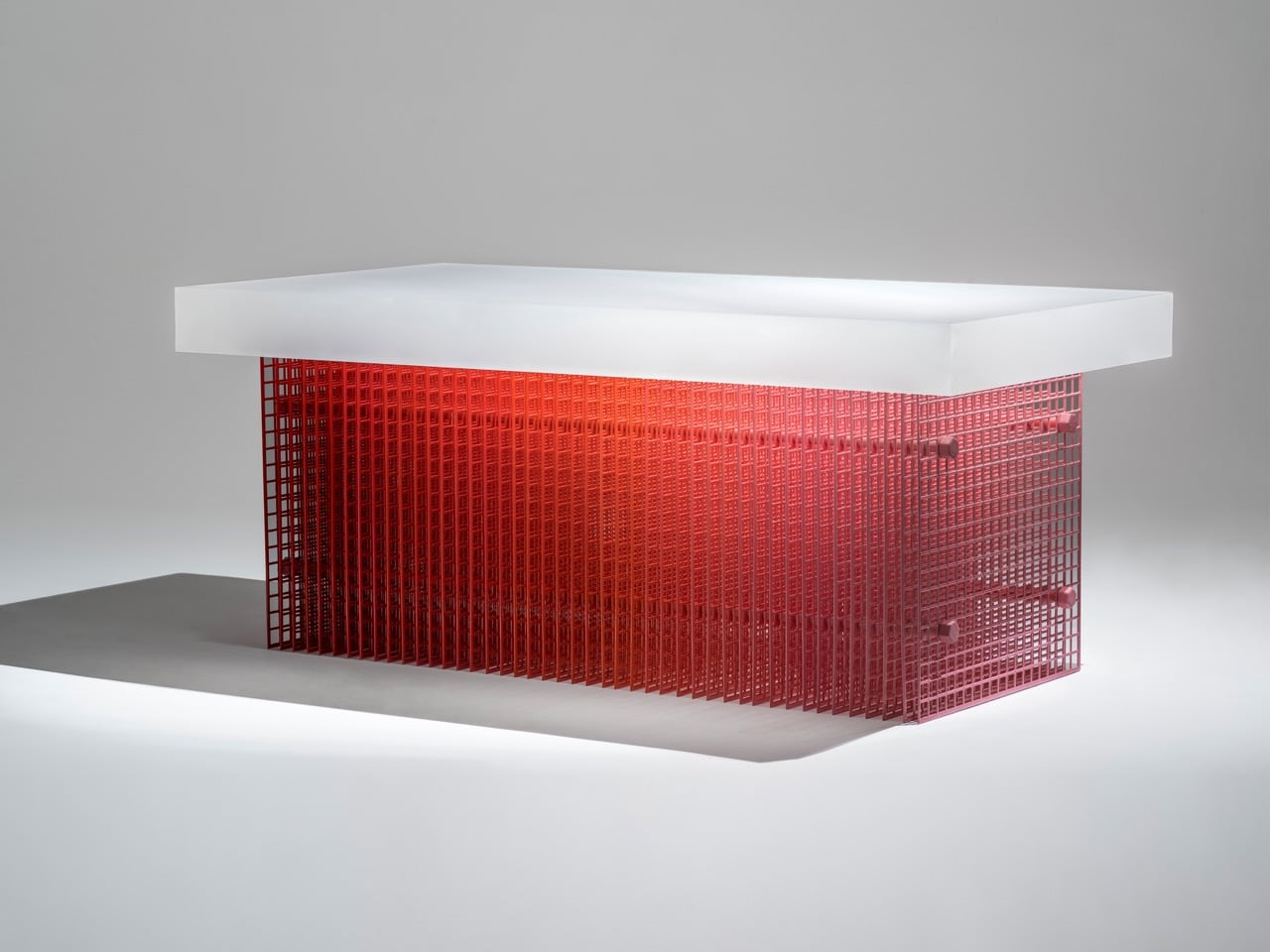
The Moire effect emerges when two or more repetitive patterns overlap at a slight offset or angle, producing a third, emergent pattern at a much larger scale. It is the same phenomenon that makes a window screen look striped when photographed, or causes two chain-link fences to generate waves when viewed at an angle. In Blur, the layered mesh panels are the mechanism, and the enamel coating is the amplifier. At 112 x 56 x 45 cm, the table is coffee table scale, low and rectangular, which means the base sits in the viewer’s sightline rather than below it. You look across the mesh, not down at it, which is precisely the angle at which moire interference is most pronounced.
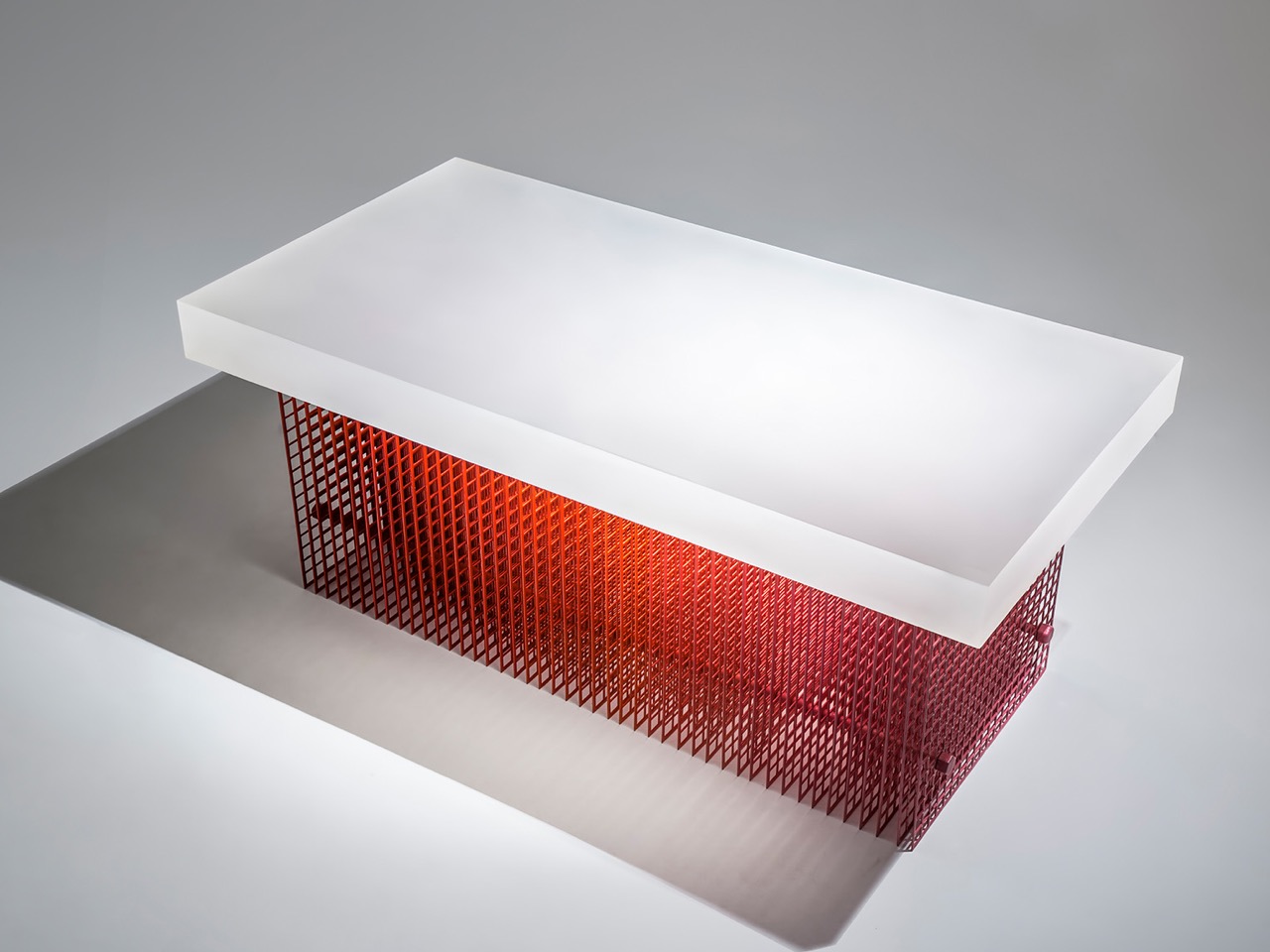
What separates Blur from the broad category of studio furniture that deploys traditional craft as surface-level ornamentation is that the Meena enamel technique is load-bearing to the concept, not decorative dressing applied after the fact. The irregularity is the point. A machine-applied coating would produce a uniform surface, and a uniform surface would kill the moire entirely, flattening the mesh into something predictable and inert. Agarwwal needed the hand, the slight inconsistency, the human error baked into a centuries-old process, to make the optical effect function. The craft and the perceptual phenomenon are causally linked, not just thematically paired, and that is a genuinely uncommon design position to arrive at and execute convincingly at furniture scale.
The post Dhruv Agarwwal’s Blur Coffee Table Turns an Optical Illusion Into Furniture first appeared on Yanko Design.


0 Commentaires